Attributing rising sediment loads to their sources — tributary by tributary, across two sub-basins — using nine years of satellite data.
This project was delivered by Philipp Grötsch as an individual contractor to an international development bank.
The Batang Hari and its tributaries drain a large swath of Sumatra's interior, supporting riparian communities, fisheries, and downstream water users across the province of Jambi. Over the past decade, satellite imagery and local measurements have shown worsening water clarity throughout the basin — mining is widely regarded as a primary culprit, yet a direct link was difficult to establish without comprehensive data.
This study used nine years of Sentinel-2 satellite imagery to track suspended matter concentrations at ten strategic confluence sites across the Tebo and Tembesi sub-basins — where mining-affected tributaries join larger rivers. The goal: attribute increasing sediment loads to specific upstream sources and quantify how fast those loads are growing.
Beyond visible sediment, the findings carry implications for heavy metal contamination — mercury, lead, arsenic, and other mining-associated pollutants that travel the same pathways and accumulate in aquatic food webs relied upon by local communities.
Mining is spreading across remote headwaters. Proving cause and effect — at basin scale, over years — requires a more than localized grab sampling.
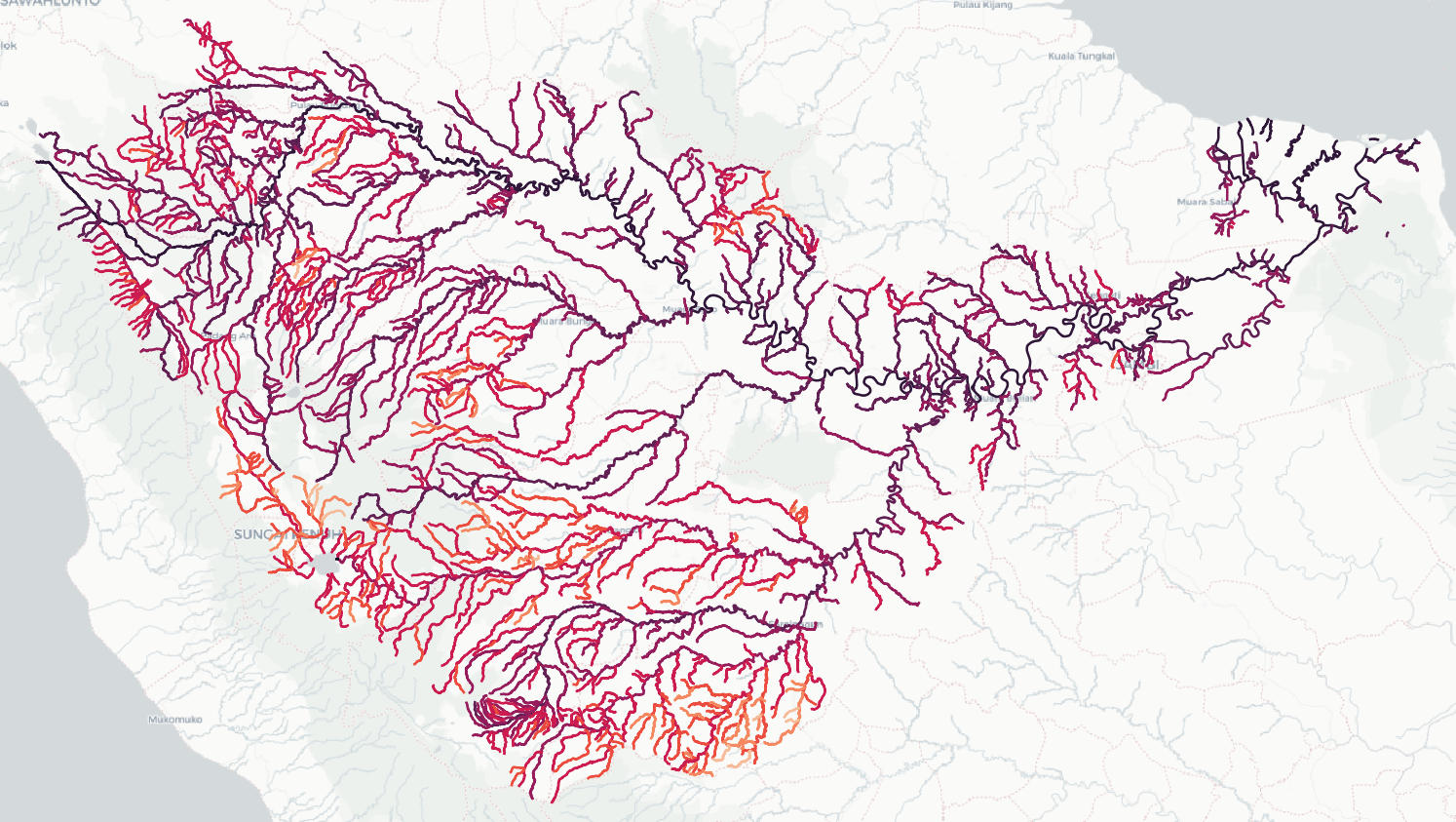
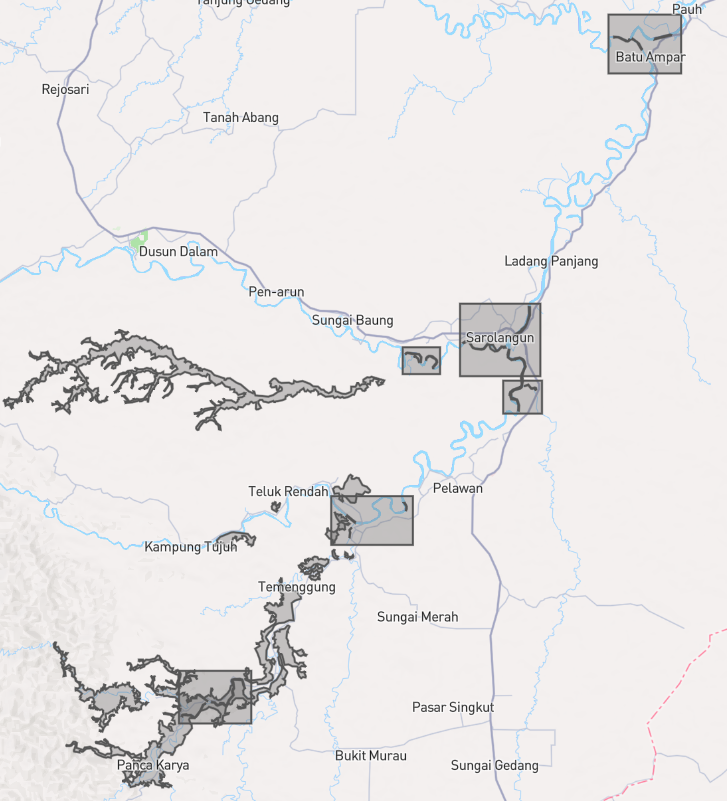
Batang Hari watershed with ranked tributaries. The monitoring challenge spans hundreds of waterways across a remote, cloud-prone equatorial basin.
Mining activities occur deep in Sumatra's interior — areas where physical sampling is logistically difficult, expensive, and provides only isolated snapshots in time. A basin-wide picture requires a different approach.
Some of the most impacted waterways are too narrow to resolve with 10 m satellite imagery. Their influence must be inferred from concentration changes in the main river immediately downstream of their confluence.
Rainfall events, seasonal flooding, land-use conversion, and peat drainage all affect sediment loads independently of mining. Distinguishing anthropogenic from natural sources requires multi-year trend analysis, not single-event observation.
Tropical cloud cover is highest during rainy season — precisely when sediment transport is most intense. Single-date analysis is unreliable; only long-term statistical aggregation yields robust results.
River discharge is largely unknown across this basin, making mass-balance calculations impossible with conventional methods. The analysis instead focuses on concentration distributions and relative indices — metrics that are informative even without volumetric flow data.
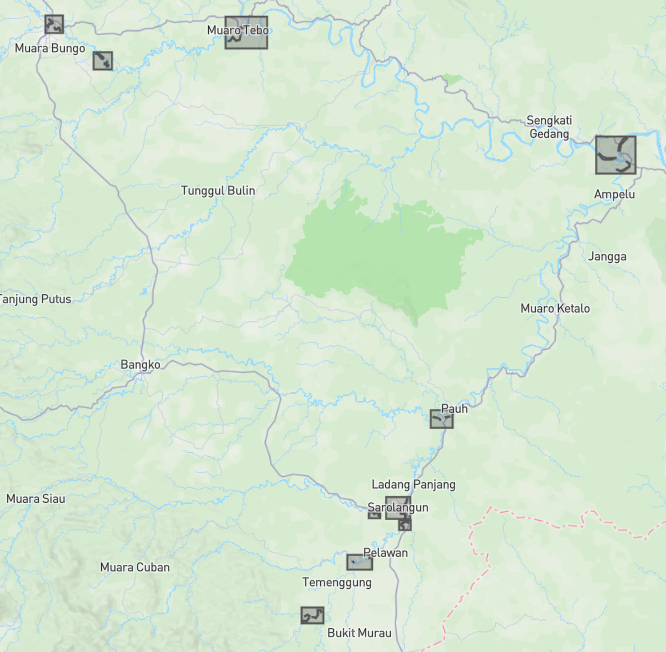
The full Sentinel-2 archive from 2016 onward was ingested, atmospherically corrected, and processed to water quality parameters across the entire basin extent. At each of ten strategic confluence sites, three sampling zones were defined: the main river upstream of the confluence, the tributary, and the main river downstream — allowing the sediment contribution of each tributary to be directly quantified.
Seasonal variability was separated from long-term trends using STL decomposition and Mann-Kendall trend tests. This combination distinguishes mining-driven increases from natural annual cycles — and identifies where sediment loads are accelerating fastest.
Every available Sentinel-2 scene from 2016 to 2025 was processed to suspended matter concentrations across the full river network — establishing seasonal baselines and capturing multi-year trends that short-term sampling programs cannot reveal.
At each of the ten confluence sites, Tributary and Dilution Indices quantify how much sediment each mining-affected tributary contributes to the main river — and whether that contribution is growing over time. The method works even for tributaries too small to resolve directly.
Mann-Kendall trend tests and STL seasonal decomposition were applied to every location of interest — producing a spatial map of where sediment loads are rising, at what rate, and how far upstream the signal can be traced.
At nine of the ten confluence sites analyzed, tributaries draining active mining areas contribute elevated sediment loads to the main river — and at most sites, those loads are increasing year over year. The signal strengthens as you move upstream toward the source.
The attribution chain is unambiguous in the Tembesi basin: Sungai Mesao feeds Sungai Limun, which feeds the Batang Asai, which feeds the Tembesi, which feeds the Batang Hari. At each step, the dilution index confirms the upstream tributary as the dominant sediment source. The Rantaugadang mining area — draining via Sungai Salembau — is a particularly clear example: a concentration jump visible in the satellite data from 2019–2020 onward, with rates of increase accelerating since.
These trends are corroborated by independent turbidity measurements from BWS Sumatera VI (the regional water authority), which show the same multi-year increase in the Batang Hari and Tembesi.
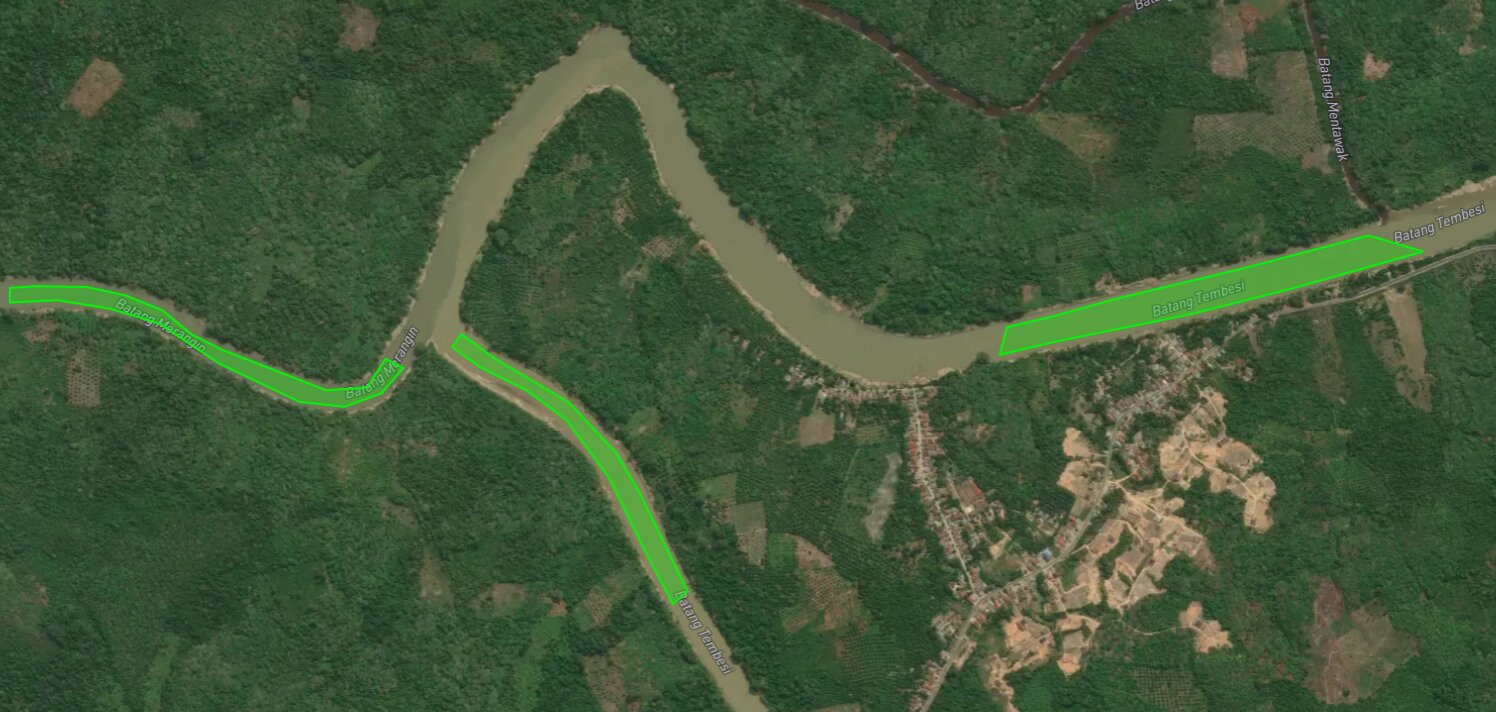
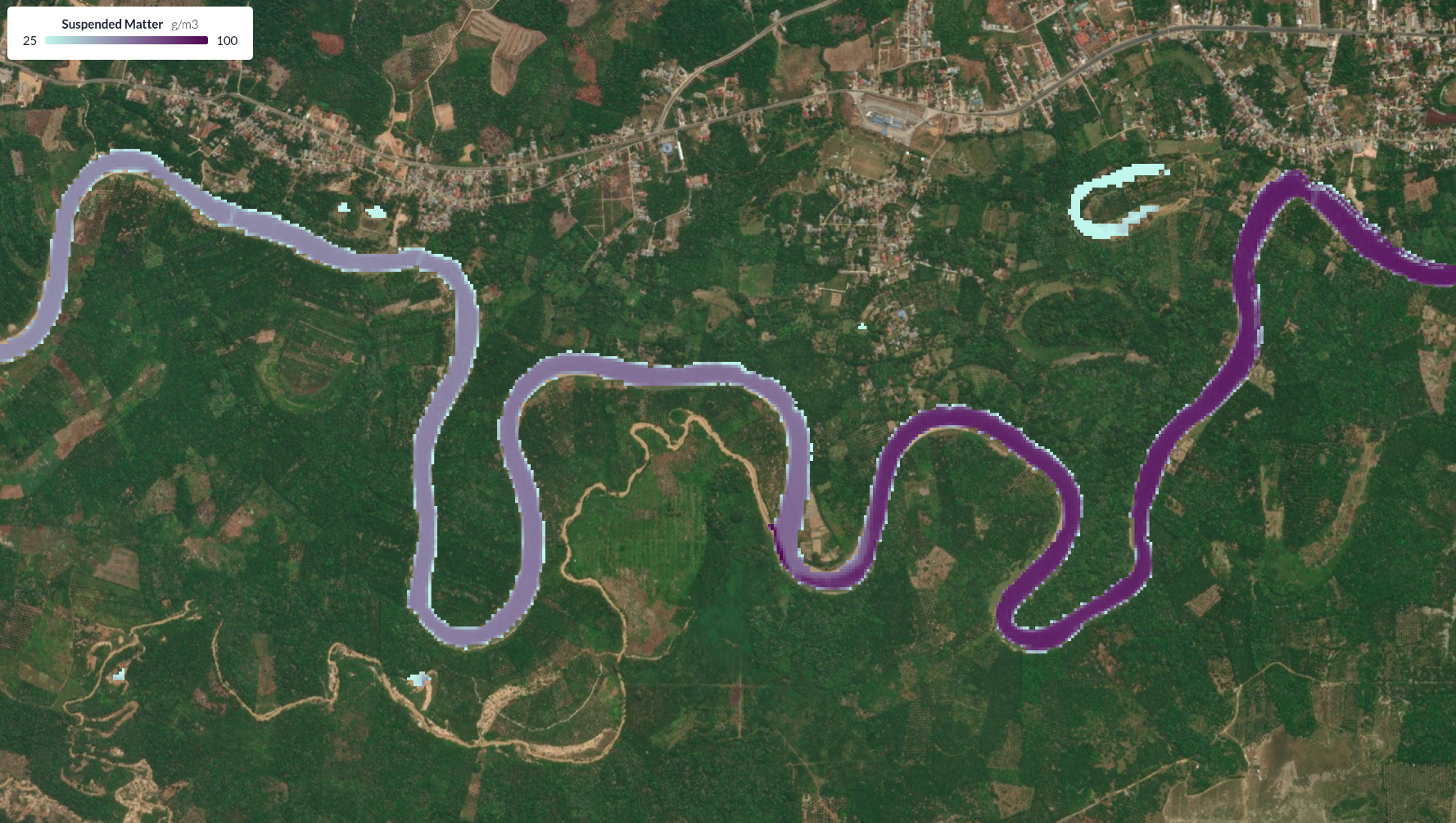
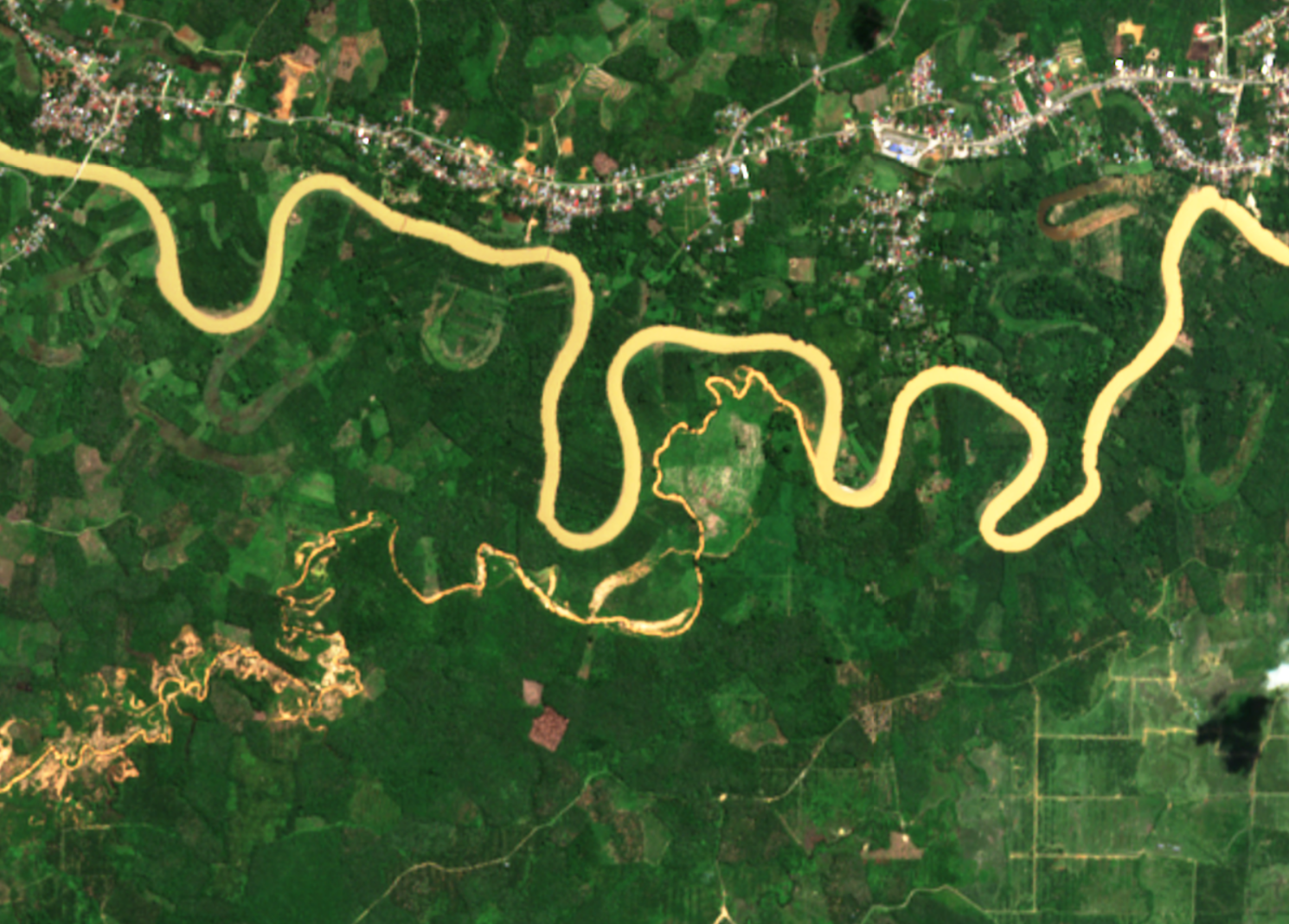
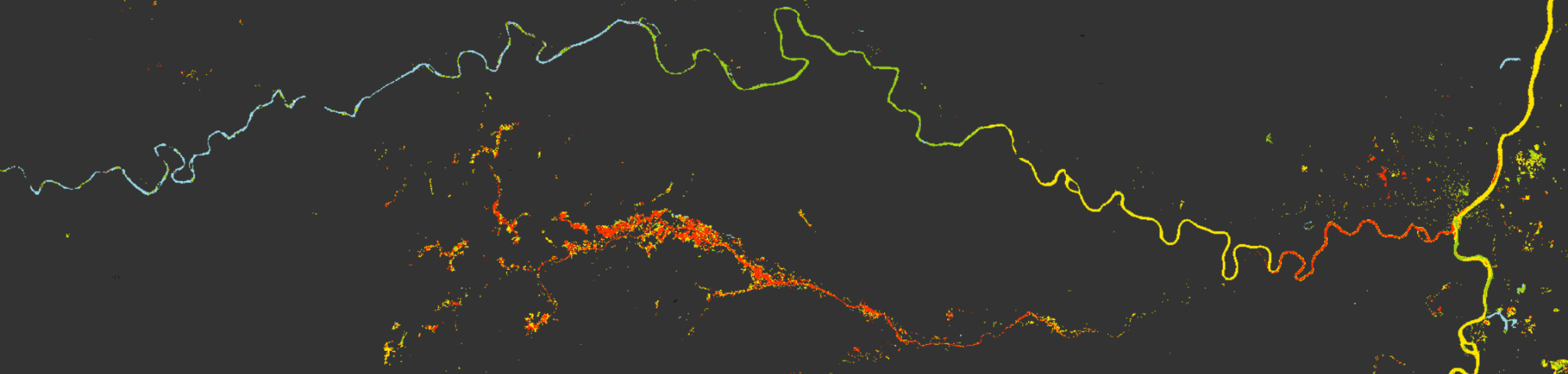
The Sungai Salembau is a tiny tributary draining the Rantaugadang mining area into the Batang Tembesi. In a true-color satellite image, the confluence is barely visible. In suspended matter concentration derived from the same image, the mining-sourced sediment plume stands out clearly — and its increasing trend over time makes the attribution unambiguous.
Left: true-color (RGB) view. Right: satellite-derived suspended matter concentration. Same scene, same satellite — processed differently. The impact of this small mining tributary is nearly invisible in RGB and unambiguous in SPM.
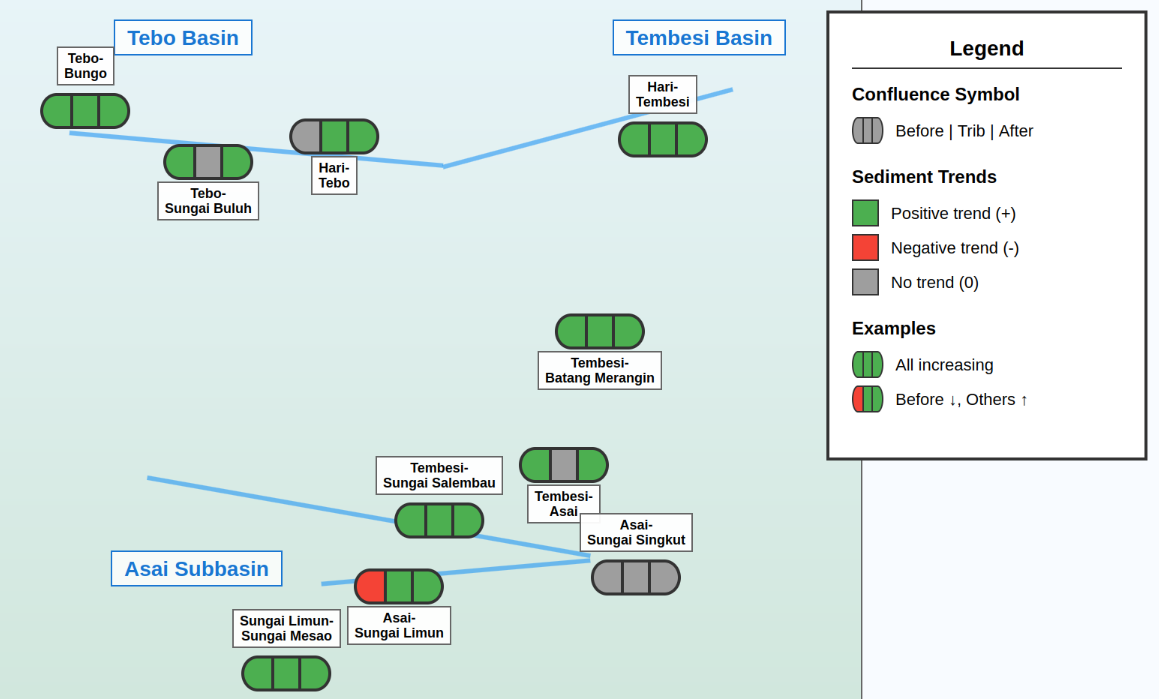
The trend analysis paints a coherent picture: the further upstream toward active mining areas, the faster sediment concentrations are increasing. The Sungai Buluh (4.8 %/yr) and Batang Bungo (4.4 %/yr) — both draining established mining districts in the Tebo basin — are the fastest-growing sources. In the Tembesi basin, the chain Sungai Mesao → Sungai Limun → Asai → Tembesi → Batang Hari shows a consistent downstream cascade, each confluence adding to the cumulative load.
Spatial schematic of sediment concentration trends across all ten confluence sites. Trends derived from Mann-Kendall test applied to the 2016–2025 Sentinel-2 archive.
| Confluence | Mean SPM — tributary (g/m³) | Relative trend (%/yr) |
|---|---|---|
| Tebo – Sungai Buluh | 273.8 | 4.8 % |
| Tebo – Bungo | 201.5 | 4.4 % |
| Sungai Limun – Sungai Mesao | 262.2 | 4.1 % |
| Tembesi – Sungai Salembau | 245.7 | 3.1 % |
| Batang Hari – Tembesi | 230.3 | 3.0 % |
| Batang Asai – Sungai Limun | 310.9 | 2.3 % |
| Tembesi – Batang Merangin | 171.1 | 2.4 % |
| Batang Hari – Tebo | 219.6 | 1.6 % |
Suspended matter concentration in each mining-affected tributary and corresponding relative trend (% per year). Rates without statistical significance omitted. Source: Mann-Kendall trend test, 2016–2025 Sentinel-2 archive.
"The research demonstrated a clear attribution of increasing sediment loads to mining operations throughout the watershed. Our methodology proved effective for trend analysis despite challenges like cloud cover and spatial resolution limitations."
Dr. Philipp Grötsch — Aqualytics
The approach used in the Batanghari study — long-term satellite trend analysis, confluence attribution, and spatial fingerprinting of pollution sources — is deployable anywhere in the world with Sentinel-2 coverage. No sensors required for an initial assessment. We work with environmental agencies, conservation organizations, and development institutions to turn satellite archives into evidence.
Whether you're monitoring a single watershed or building a basin-wide evidence base, we can help.
Get in touch